

Daryl Taylor: Airbus Senior Vice President of U.S. Commercial Aircraft Operations
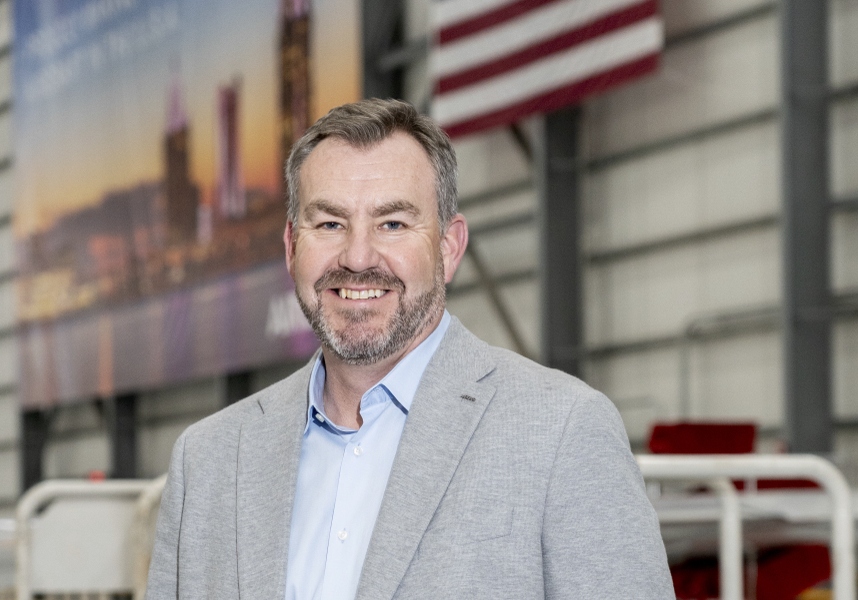
The U.K. native-turned-Southerner talks about the growth of the company and the aerospace industry, coming full circle and building the future workforce.
by Kaija Wilkinson
photography by Stephen Savage
In fall 2025, your author had the privilege of visiting Airbus Senior Vice President of U.S. Commercial Aircraft Operations Daryl Taylor during an exciting, pivotal time for the executive: Taylor had just moved into his new office on the fourth floor of Airbus’ second A320 Final Assembly Line (FAL), which had been
inaugurated only a week prior. The building — consisting of office and manufacturing space within 350,000 square feet — smelled of fresh paint. Elevator interiors were sheathed in protective coverings as
furniture was moved in. Taylor’s walls were bereft of photos or artwork. From Taylor’s new vantage point, he could see Airbus planes as they took off, bound for their new homes and new owners.
While growing up in Wrexham, North Wales, Taylor was never a child who pointed to the sky in amazement at jets as they flew by, but he definitely gets a thrill out of seeing a finished product — these
days Airbus A320 and A220 aircraft — take flight and knowing that he and his team had a part in making that happen. Taylor says:
“The product we make is pretty incredible. I’ve been lucky enough that, for most of my career, I’ve been able to see the product we make fly away from my facility. When you’re looking out the window and seeing what you built, what your team built, head on its way, it is very exciting. Also, now that I’m on the commercial aircraft side, I love it when I catch a flight, whether it’s in the U.S., the U.K. or France, and
know that my team built the aircraft or our colleagues in Europe or Canada built it.”
The son of members of the Royal Air Force, Taylor began his aerospace career as an apprentice at British Aerospace (now Airbus in the U.K.) right out of high school when he was 16 years old. Taylor grew up in Wrexham, before Hollywood actors Ryan Reynolds and Rob McIllheny bought the Wrexham football (soccer) team, and hardly anyone knew where his hometown was, Taylor says. Now, he says, especially
with an award-winning documentary about the town and its soccer team, a lot of people know about Wrexham, which will always hold a special place in Taylor’s heart. Wales, he says, is similar to Scotland or Ireland in spirit, weather and terrain. Wales is especially magical around Christmastime, he observes, adding: “It’s quite different from Mobile. Santa is not wearing shorts on the beach.”
Despite challenges in the aerospace industry in the 1990s, Taylor was fortunate to join Raytheon Aircraft, which later became Beechcraft. He initially came to the U.S. with his young family (at the time a wife and baby daughter) in 1997. “We thought we were going to have a regular American adventure for two years, and now, 28 years [and two sons plus three grandchildren later, we’re not quite done with that American adventure!” he jokes. All jokes aside, Taylor and his family now consider Mobile home. The couple’s two
sons were born in Kansas but they are now Southerners through and through. His daughter, born in Toronto, has nostalgia about being born somewhere else, but considers the U.S. South home and is raising her daughter here.
Meanwhile, Taylor continues to play an active role in the growth of Airbus and its future workforce. Based on the momentum achieved in only 10 years, the future looks bright, he says. Taylor (DT) took the time to speak to your author (KW) about his career and what Airbus means for the local community and beyond.
KW: Tell me about the apprenticeship program in the U.K. where you got your start.
DT: The program was really strong in creating a foundation in aerospace knowledge. It was a five-year program that included a lot of academic and classroom time, followed by time on the shop floor in the operation support functions. It was supported by professional mentors. It’s funny, even 30 years on, I realize that what I learned then has somehow been ingrained into my DNA.
KW: You began with Airbus. Describe your career after that.
DT: After my apprenticeship, I left Airbus and joined Raytheon Aircraft Co. as a manufacturing engineer supporting the production of the Hawker Business Jet. In that role, I found that I was much more comfortable on the shop floor than I was in a design office. After a couple of years of working in Wales, I got the chance to come to the U.S. as they were moving production from the U.K. to their headquarters in Wichita, Kansas. I intended to do that for two years, but a year and a half in, I got the opportunity to
stay and ended up being there a total of about 12 years, first as a manufacturing engineer. I then got into quality control and continuous improvement using the Lean and Six Sigma programs and even spent a little time on the sales and marketing side of the business. Eventually, I got the chance to step into operations leadership, initially leading the assembly line for the product I’d help move 10 years earlier. So, that was kind of serendipitous for me. It was my first experience with a full operations role. Before leaving, I was able to take the operational lead on a couple of different products for them.
After Raytheon, I had the opportunity to join a former Airbus colleague who was leading the Bombardier facility in there. I was the general manager for the Bombardier product they built in Toronto, the Q400 (a twin-engine turboprop regional aircraft known for its high-speed performance.) I was responsible for the
end-to-end operations through to final delivery to the customer. After four years in Toronto, my wife and I were at a crossroads, thinking, ‘OK, are we staying in Canada, going home to the U.K. or going back to the U.S.?’ We decided on the U.S., and I was fortunate to get a job as a general manager for GKN Aerospace in Wichita. I worked for them at their Kansas facility and also in California for a couple of years. Then, about 10 years ago, I got a call from Airbus, and it was like it was all coming full circle. I had about a 20-
year break between being an apprentice and being the vice president and general manager for Airbus’ U.S. Manufacturing Facility. After 20 years and 5,000 miles, it was like coming back home.
KW: Can you walk me through what your team does here and what’s on the horizon?
DT: Our U.S. Manufacturing Facility in Mobile is responsible for assembling and delivering A320 and the A220 family aircraft. We opened our first A320 FAL in Mobile in 2015. The A320 has evolved to become the most successful commercial aircraft family in history. While the A320 FAL in Mobile was originally established to serve the U.S. market, its success has driven expansion and we have started manufacturing A320s for Latin American customers, as well. We inaugurated our second A320 FAL in October 2025 to support Airbus’ global single-aisle ramp-up.
Our second and newer product line is the A220. Originally developed by Bombardier, Airbus finalized the aircraft’s integration into the Airbus family in 2019. We opened our A220 FAL in Mobile in 2020.
In terms of aircraft production, we do not manufacture the individual parts from scratch here in Mobile; rather, we bring them together. This process relies on a massive global supply chain. Major components such as fuselage sections, wings and tail cones are manufactured in Europe and other parts of the world.
They are shipped across the Atlantic, arriving at the Port of Mobile where they are offloaded and transported via the local rail and road systems to our facility at the Brookley Aeroplex. Once here, our team assembles these major components to produce a finished aircraft. Ultimately, the process concludes when our customers arrive at the facility to take ownership of their new aircraft.
KW: You mentioned ‘built for the U.S. market.’ What does that mean exactly?
DT: Airbus also has FALs in Toulouse, France; Hamburg, Germany; Mirabel, Canada; and Tianjin, China. Obviously, the facilities that are in Tianjin and Mobile were placed there to be closer to customers in those regions. The Tianjin facility takes care of customers in China and some in the Asia-Pacific. We generally
take care of North American and Latin American customers out of this facility. There’s no difference in the product except for what the customer might specify — different paints, different cabin interiors, etc. But, in general, the aircraft isn’t technically different.
KW: What does leadership at Airbus Alabama mean to you, particularly when it comes to cultivating talent from within?
DT: We provide multiple pathways to cultivating talent. From day one, we’ve opened the facility up for external tours. School counselors, teachers and kids began to come through with the launch of Flight Works Alabama (FWA, an interactive aerospace exhibition and education center at Airbus) right at the time of COVID. FWA’s Flight Path 9, (a pre-employment training program designed to prepare individuals for a position at Airbus’ Mobile facility), created another pathway for students to learn about what it means to join aerospace. They don’t have to be an engineer or a pilot: We show them that there are many, many different jobs — finance, communications, legal— in this industry. There are obviously the trades, as well, and engineering. The first thing that exposure does is give people an understanding that, ‘Yes, I can work in this industry and do lots of different jobs.’ Also, when you step into this facility you see a brand-new, clean, safe, air-conditioned and actually very quiet facility. The pictures of what people thought manufacturing jobs looked like from the 1970s are no longer accurate.
Anyone’s son or daughter who comes to work here is going to have great pay, great benefits and a great work environment. We’re very proud of the products Airbus builds here. We have a significant backlog, so there’s job security that comes along with joining us. We’ve got a good relationship with Bishop State. Using FWA’s Flight Path 9 program, we’re creating a vehicle for kids to come and join us. They get to do it after class in high school and during the summer. Then, what we’ve done since 2022 is an apprenticeship program that pays these young adults very well from day one. They come onboard with a full benefits package — all that you would get as a full-time employee. (Through FWA and Bishop State Community College, students earn 18 credit hours and a certificate in Aviation Manufacturing Technology). We’re very
proud when we see other generations join. We’ve had parents join us after their son or daughter was an apprentice because they’ve seen what that can do. Word of mouth does more than anything.
KW: Tell me about Airbus’ commitment to creating clear career paths.
DT: The engineering team here in Mobile, led by David Trent, laid the groundwork for what we do on the
manufacturing side. The relationship they have with the University of South Alabama and B.C. Rain High School set the foundation and created credibility for us to step in. It’s a symbiotic relationship. When the FAL opened, we saw several team members from this facility go over to [Trent’s] team into engineering
roles. We’ve created a broader set of opportunities. Internally, we want team members to develop so we’ve created opportunities for people to progress through the trades. We’ve trained people as mechanics who then move up to flight line mechanics, which is a higher- skill, higher-paid role. The same goes for electrical and avionics where, with FWA, we’ve created opportunities for shop floor operators to become manufacturing engineers. We’re going to do that with two or three other types of roles. We’ve been really successful in retaining local talent, and we are committed to continuing to create opportunities where the team feels like they can continue to grow.

KW: How big of a role does automation play in the Airbus manufacturing process?
DT: At the moment, Airbus is really focused on finding the “right” level of automation. Aerospace manufacturing is a lot different from the automotive industry, which is highly automated. Think about the speed of production. It isn’t like every minute or two a component moves along. It’s a lot more static. It’s hard to automate building large pieces of a ship or large homes, and it’s the same with an aircraft. I think that’s one of the great things about this industry: There is no way we’ll ever automate the human element out of it. That’s not our intent anyway. As we have expanded and added our new lines, we have added some targeted automation in fuselage and wing-joining and into our logistics flows. Our intent is to automate so we can allow our employees to focus on high-value tasks. We don’t want to create automation just for the sake of automation.
KW: How does Airbus give employees the opportunity to apply their skills in ways that benefit the local
community?
DT: [Trent] and his team set the standard on this, getting into schools and reinforcing Science, Technology, Engineering and Math (STEM) education. Our biggest focus is around STEM education in local schools. It’s a little harder in the manufacturing environment than in engineering because it’s difficult to have two or three manufacturing team members leave the floor in the middle of a shift to volunteer. So, we have to be a little more creative. In addition to encouraging young people to join Airbus and facilitating employee growth, we have employee resource groups that focus on issues they care about that align with our values.
KW: Are you optimistic about the new mayoral administration?
DT: We try to avoid pure politics, but for the past 12 years we’ve been very well supported by Sandy (Stimpson) and his team and the Mobile County Commission. When you go back to the decision about
why we came to Alabama in the first place, it all comes down to the alignment we saw from city, county, state and local business leaders. I can tell you there is nowhere else that supports us this well. So, to answer your question about the transition, it appears the transition to Mayor Cheriogotis will be seamless and business as usual.
KW: How do you see Airbus’ role evolving in the Mobile Bay business community over the next five to 10 years?
DT: Over the past 10 years we’ve been able to put Mobile on the aerospace map. Now, we need to reinforce that. The chamber has done a lot of work over the last four years and we have about 30 suppliers here now. We would love to see some bigger suppliers, some more scale. The reinforcement of our educational and facilities ecosystems will continue. What the Airport Authority is doing to revitalize Brookley and the Mobile International Airport is exciting. I’m looking forward to seeing what will be done on the other side of I-10. We’re creating a sort of greenfield/brownfield environment where key elements are bringing a real supplier ecosystem to the region. Resources, education, facilities and logistics are ramping up. Over the next five to 10 years, Mobile will be recognized as much more of an aerospace center, and not just for Airbus.
KW: What advice would you give to fellow executives about building deep local roots while managing global operations?
DT: Engage. Be present. I’ve been lucky over the past 10 years that I was very engaged and present, especially early on because we’re a relatively small organization. You have to listen and understand that you’re part of a community. Mobile’s a special place. There’s very strong engagement in civic and philanthropic efforts, as well as the desire to truly engage the region so it lives up to its potential. Being transparent is the other key piece. You need to be transparent about the topics that are reported to you and understand which topics are important to the community so you can find the right answers. Step in, listen, learn and participate. It takes time. The easy answer is ‘I’m too busy,’ but you’ve got to make it a priority.
KW: Looking back on Airbus’ time in Mobile, of which milestones are you most proud?
DT: We have so many milestones to be proud of, and each one is special. The opening of our new FAL [in October 2025] is certainly one, but it really comes down to two things. One is the success of those
first two to three years when we started this facility. I think there were unknown expectations by the Airbus organization: Would we be able to ramp up and grow? I think the fact that, within three years, we
announced we were going to build the A220 here was a really proud moment for me. The team was like, ‘OK, we’re actually going to grow, and grow quickly.’ It was unheard of inside Airbus. It’s not normal, and obviously to do that again within 10 years (with the new FAL) is something we’re really proud of. The second thing is the whole educational element. For me, it was a full-circle moment in my career seeing that first group of Flight Path 9 apprentices being hired by us here in Mobile and knowing that’s how I started my career 30-something years ago. It’s something that goes beyond you or me or anyone who’s here today. With Flight Path 9 and our relationship with Bishop State, we’ve generated close to 300 employees. We’ve created a shift for a group of young adults who wouldn’t have otherwise had the opportunity. So, I think that’s the absolute bumper sticker for me.

Read More


Subscribe to our weekly newsletter
Sign up here for free to get Bay Business News email newsletter every Friday.
By subscribing, you agree to our User Agreement and Privacy Policy & Cookie Statement.