

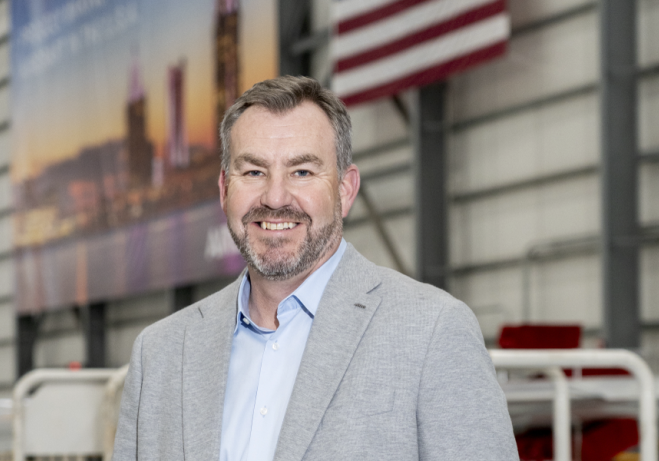
Josh Hembree, Owner and President, Hembree Heating & Air Conditioning
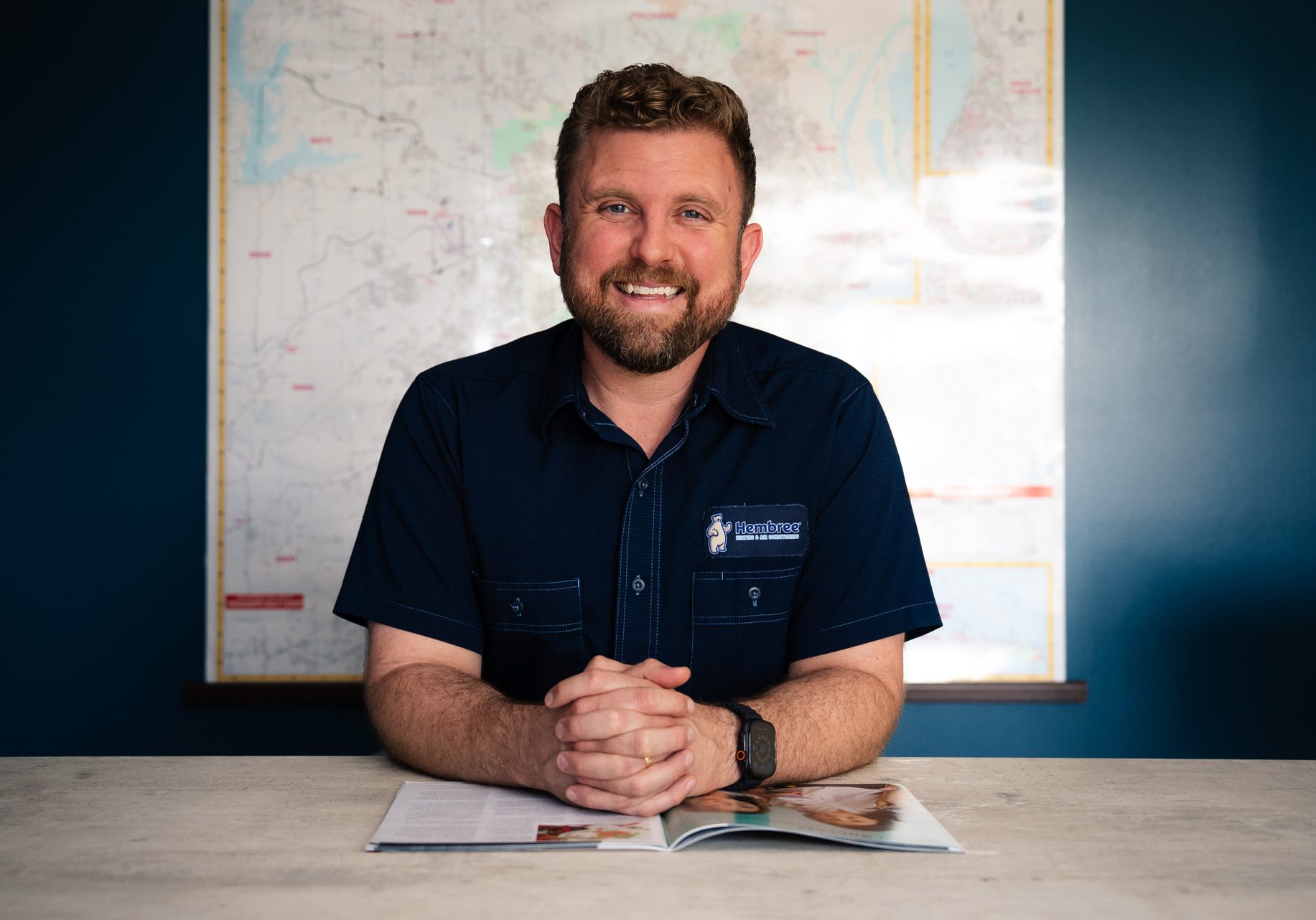
Leader of 57-year-old family enterprise talks about life, the HVAC industry and what makes his company stand out.
photography by Kevin Zhou
“These are my law degrees back here,” said Josh Hembree, gesturing to the framed diplomas behind his desk at Hembree Heating & Air Conditioning on Tanner Williams Road in West Mobile. The degrees are reminders of Hembree’s life as a lawyer in Montgomery, Alabama, a career he achieved after striving since childhood toward that goal, ultimately earning a Juris Doctorate from Jones School of Law in Montgomery and passing the bar. For much of his 20s, Hembree worked for a white-shoe law firm doing estate work, handling trusts and wills. He loved it, but he also loved growing up around the family business founded by his grandfather, Walter Donald Hembree, in 1969. He still has the original sign from his grandfather’s shop hanging in the office, a reminder of humble beginnings when the company operated out of a single truck. “He was a one-man show,” Hembree said of his grandfather. “He knew how to work on air conditioners, and that’s what he did. It was ultra-simple.”
In the 1980s, Walter Hembree became disabled as a result of trying to pick up an air conditioner by himself. “It was just kind of the way of the world back then,” Josh Hembree said. “You just did stuff yourself.”
Despite it being just one man, the business was successful and had grown a small, loyal customer base. Walter Hembree didn’t want to just walk away. So, Walter’s son (and Josh’s father), Walter Hembree Jr., dropped out of high school at age 16 — essentially still a child — to take over the family business. Walter Jr. knew he needed to hire people. He wanted to avoid getting hurt, but he also wanted to grow the business. “So, by the grace of God and a lot of hard work, he built a small company with four or five employees,” Josh Hembree said.
Throughout his childhood, Josh Hembree knew the business supported his family and helped a lot of people. “I loved that, but throughout my life my dad discouraged me from following in his path.” And the law beckoned.
Then, approximately eight years ago, Walter Jr. decided to retire and “sell the business to the highest bidder.” He called his son, who was living and practicing law in Montgomery at the time, to break the news. That sat uneasily with Josh, who had “a supernatural love for my family’s legacy.” He said after a lot of “thought and prayer,” he decided to come home to Mobile to take over Hembree Heating & Air and “be the next generation of our family’s business.” Everyone said he was crazy for leaving the prestigious law world, but Josh Hembree couldn’t be happier with his decision. Hembree (JH) took the time to speak with your author (KW) via Zoom about what it’s like to run a family-owned HVAC business — a rarity in today’s world of private-equity ownership — his business and life philosophy, technology trends and more.
“Making money is an honorable goal we are all chasing, but there are times in life when you have to care for the person before money, and we are running everything we do at Hembree through that lens.”
KW: You are a Mobile native, right? How far does your family go back?
JH: Oh yes. Four or five generations, at least. I know my great-great grandparents lived here.
KW: The company does both sales of the top air-conditioner brands and maintenance. Which represents the lion’s share of business and revenue?
JH: The majority of our revenue comes from sales of new equipment. Maintenance and repair is the minority, which is normal for the industry. For the average HVAC company, revenue is about 25% from service and maintenance and 75% from sales, and that’s just because new equipment costs quite a bit more.
KW: What’s the price for a new air-conditioner system? Do they cost as much as 20 grand?
JH: They can! But it starts at around $8,000 and then can go up into the tens of thousands. That’s the top of the line — all the bells and whistles. We don’t sell those every day. Even if people have the money, they’re like, “Do I really want to spend that much on an air conditioner?” Those really high-end ones, they’re more efficient so they use less electricity, but that’s not even the main reason people buy them. The main reason is to de-humidify the air.
KW: Describe your customer base.

JH: Sixty percent of our customers are residential — everybody from homeowners to landlords — and then 40% is commercial. That includes doctors’ offices, banks, restaurants, shopping centers, things like that.
KW: How many employees do you have? Are you hiring?

JH: Twenty-five employees is our budgeted size for this year. And the answer I would like to give is, yes, we’re always hiring, because my growth as a business is not limited by marketing. We’ve got that pretty much figured out. We can always ramp it up and make the phones ring more. Our growth is limited by finding highly skilled people who are also full of integrity, because if they don’t have both, they’re not going to make it on our team. That’s because we have a high standard on a personal level and on a professional level. Those people are kind of rare. I know a lot of wonderful people who are full of integrity and character, but their HVAC skill set is not there. On the flip side of that, I’ve seen some highly skilled HVAC people come through and the integrity is just not there. So, when I find somebody with that combination of integrity and skill — that canary, that rare bird — we make room for them.
KW: Has any new technology, such as AI, helped or affected the company in any way?
JH: The short answer is yes — tremendously. I can probably talk about that for at least 30 minutes. The company that I stepped into eight years ago was pen and paper. We had a website, but it was ultra simplistic. Now, we’re very sophisticated from a technological perspective. We’ve built a state-of-the-art website, and we’ve also integrated operating software. AI is controlling a lot of that. It is literally routing our technicians for us. We want to optimize our routes, because we drive all over the place, and driving time is a big deal. If you’re not making our routes efficient, then we’re spending too many hours on the road, and we can’t take care of as many people on the same day.
KW: Does AI also help with budgeting and things like that?
JH: I think the financial benefit of AI comes in the form of our marketing budget. We have AI overlapping all of our marketing expenses. It’s tracking the performance of all of our various marketing vendors. Then we can say, “Hey, this vendor is doing great as far as producing leads for us. Let’s give them more money.” Or, let’s cancel that vendor because it’s not working out so well. AI helps us make those decisions, versus historically when it used to be more of a gamble.
KW: Which geographical areas do you cover?
JH: All of Mobile and Baldwin counties, and business is pretty evenly split between the two.
KW: Other than being an employer, how does Hembree give back to the community?
JH: Giving back and supporting people is tremendously important to me, and we are always looking at ways to do that. We give away a lot of money, but most of it is not publicly known. We do a lot of free air-conditioning work for people in need, basically because it’s the right thing to do. We support a lot of little league teams — I think we’ve got about 40 right now — and we give to quite a few charities. I believe the Lord has blessed our company, and I want to be a steward and light in the community.
KW: Tell me about your family.
JH: My wife, Kala, and I are celebrating our 10th anniversary this year. We have a 5-year-old son, Brenton, and an 8-year-old daughter, Eva. They’re a lot of fun. We’re out of the baby season and in peak childhood season right now and having a ball. It’s magical. And Kala has built a sort of bread empire. Several years ago, she just wanted to make bread so she started baking sourdough and selling it at farmers’ markets. That was simple, small. Then at a farmers’ market one day, someone asked her, “Hey, would you please teach me how to make this bread?” And she was like, “Sure, I can teach you.” She’s a teacher by trade and taught for years in high school and college. She loves to teach. That first student led to many more, so she formed a little company and it really took off. The Bread House with Kala this year will have surpassed 4,000 students (who are taught on-site in a professional-grade kitchen at Hembree’s West Mobile headquarters). All of it is in person — not online — which is really remarkable. She’s taught hundreds of classes on baking all sorts of breads. I think she’s surpassed 30 different types by now!
KW: What’s the busiest time of year for you and why?
JH: Summer, of course. So much of the HVAC industry is weather-dependent. For companies up north, it’s the opposite. Winter is their busy season. And then our winters are mild, so we slow down.

KW: And speaking of summer, how is the company affected by major hurricanes?
JH: It’s like a slingshot. There’s a temporary pullback and delay because there’s devastation. There’s damage, no power and everything just stops. But then, the slingshot effect happens and we grow because when that damage occurs, a lot of air conditioners break. Even if there’s no flooding, oftentimes when power goes out, air conditioners get fried. If homeowners don’t have surge protectors on their air conditioners — and many don’t — a lot of electrical damage can occur. It’s sad to say because we don’t want natural disasters to happen, but storms actually increase business.
KW: Are y’all equipped, manpower-wise, to handle a post-disaster surge in business?
JH: A big part of being successful in the HVAC space is prompt response. Because if, God forbid, your air conditioner breaks this afternoon and you call us up saying I need help and I say “Of course. Our next appointment is in seven days,” even if you love us and want to use us, you can’t wait that long. We’ve seen studies that if we ask somebody to wait for more than three days, they’re going to call somebody else. I understand; I would do the same thing. So, we have to maintain a workforce that’s just a little too big so we can provide prompt service at any given time.
KW: Which leads me to my next question. What sets Hembree apart from the competition?
JH: One of our core values is we put people over profit. We are constantly pursuing how to care for and support people first, even if it means not making any money. That’s the opposite mindset of a lot of companies out there, especially the big national franchises and private equity, because they’re all about making money. And that’s not bad. Making money is an honorable goal we are all chasing, but there are times in life when you have to care for the person before money, and we are running everything we do at Hembree through that lens. On top of that, we have ultra-high standards about who we hire — the integrity and expertise thing. We also maintain the mindset of being lifelong students. We’re always learning and training and going to classes because we don’t want the customer’s home or office to be the classroom. Learning how to work on an air conditioner is something our guys learn in the classroom so they know what they’re doing when they get to somebody’s house. We have a state-of-the-art training facility here with multiple air conditioners that are operational, so when we’re on-site with the customer, we’re fully prepared for anything.
KW: What is most challenging and rewarding about running Hembree?
JH: The most challenging thing is, for instance, if somebody buys a new air conditioner from us and weeks later it breaks. It’s navigating those relationships and being empathetic with the customer and doing whatever it takes to make it right. That can be challenging, because we don’t make the equipment, and even with good intentions, manufacturers can have issues and things can break. What’s rewarding and fulfilling is the knowledge that we’re blessing and providing for 25 families and tens of thousands of customers. And then, by extension, we’re providing world-class, integrity-backed work for tens of thousands of customers that they might not have if they didn’t hire us. It’s neat to think that a humble little HVAC company — nothing exciting — can play such a big role in a lot of people’s lives.
KW: Where do you see the company in 10, 20 years?
JH: As long as things are on my watch, it’ll stay in the family. In the home services space, a lot of businesses have sold to private equity, and that’s not bad or wrong. People have to do what’s right for them. But one of our distinctions is being one of the last legacy businesses in our market, because most of my long-term competitors have sold. Everything stops at my desk; we’re not reporting to somebody out of state. I fundamentally believe in controlled, steady growth. I will never allow us to grow so quickly that we lose quality control and forget who we are.

Read More



Subscribe to our weekly newsletter
Sign up here for free to get Bay Business News email newsletter every Friday.
By subscribing, you agree to our User Agreement and Privacy Policy & Cookie Statement.