

Labor Of Love
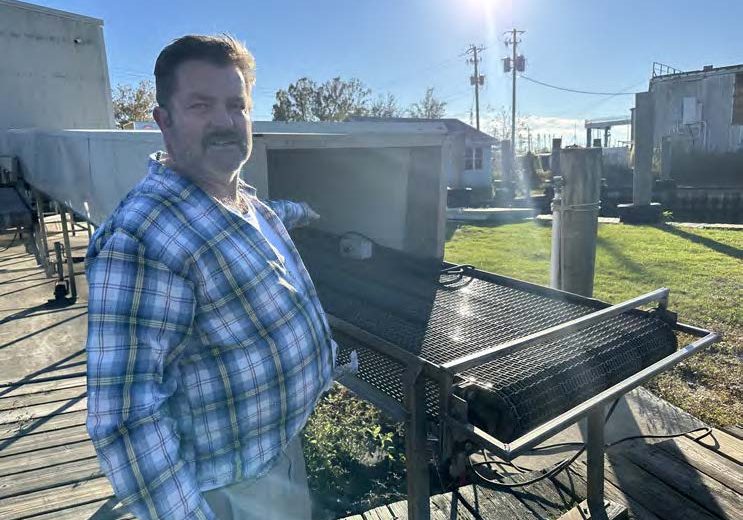
A mainstay of the local shrimp industry, Z-Packed, Inc. President Jeremy Zirlott talks about his businesses, the challenges of the industry and his contributions to a family legacy.
by T. Bruce MacKinnon
A fifth-generation professional fisherman who began shrimping with his dad at age 7 aboard the Amanda Di-Ann in the 1970s, Jeremy Zirlott launched Coden-based Zirlott Trawlers, Inc. in 1997. “Commercial fishing is in my blood,” Zirlott said, with both sides of his family harvesting Gulf seafood in Alabama for six generations now. A big year for Zirlott, 1997 saw him buy his first steel-hulled freezer boat, the Four Sisters (named for his four sisters) and marry his wife, Kim. With regulations, an influx of cheap imports and increased production costs, he and Kim realized they had to differentiate themselves. So, to remain profitable, the Zirlotts’ operation focused on high-quality, domestically harvested shrimp, with Jeremy packing the catch at sea and Kim brokering it. This new approach to their business turned into Z-Packed, Inc, an increasingly successful endeavor.
After several years of hard fishing, Zirlott bought a second boat, naming it after his two daughters, Scarlett Ariel and Emily Clair. A third daughter joined the family, so Zirlott joked he’d have to buy another boat, which he eventually did.

The current state of the shrimp industry is not making the upkeep of Zirlott’s boats and many other aspects of his business any easier. Mirroring similar situations from New England to England, Gulf Coast seafood harvesters face challenges including the “massive flood of imports that hit during COVID,”[1] according to a Southern Shrimp Alliance (SSA) trade attorney. Zirlott is among shrimpers facing challenges and is one of two Alabama representatives on the SSA — formed in 2002 to represent the interests of the shrimp industry in Alabama, Florida, Georgia, Louisiana, North Carolina, South Carolina and Texas. As he deals with imports and uncertainty about tariff implementation – not to mention rising costs for his fleet – Zirlott has no intention of walking away from the family business. It may not be as profitable as it was back in the 1970s, but it still has its rewards. For Zirlott, it’s not just a family tradition but a labor of love. Zirlott (JZ) took time to sit down with your author (TBM) to talk about his business, the state of the shrimping industry and what the future may hold.
“I love that my family has been using thesesame rivers and bayou’s to make a living for five generations”
– Jeremy Zirlott
TBM: What’s your educational background?
JZ: At 15, I woke up one morning, about four days after starting the 10th grade, and told my mother, “I’m not going back.” Of course, this created a big feud, but I had it in my mind I wasn’t going back to school. My dad said, “Look, this is not all fun and games. If you’re serious, you’re going to go to work.” And of course, that’s what I wanted to do.
TBM: What was your life like after leaving school?
JZ: By the time my brother, Simon, and I were 11 or 12 years old, we were working like men. When I left school, I went to work in a crab shop, and I was running some crab traps myself. My brother and I had a small boat. So, I was scratching out a little living. That’s what my life consisted of, and it gradually moved into buying a slightly bigger boat from my father.
He helped me rig it for shrimping, and I shrimped in the Mississippi Sound. Then, I bought another slightly bigger boat and started going out deep sea fishing in the Gulf, too. I knew that was my goal. I learned a lot from each captain I worked with. I could adjust and learn wherever I needed to go, and I was successful at it. Sometimes, I was the talk of the town. I was young, and that was a good feeling. For the next 25 years, I was fishing in the Gulf 250-280 days a year. At different times of the year, we would fish different areas, but basically the Gulf of Mexico was our backyard.

TBM: What keeps your company growing and profitable in today’s marketplace?
JZ: I’m still in business today because I’m always looking for new markets. That’s why I had to stop fishing myself. To seek out new markets and command a premium price, I had to be here to deal with the business end of things. Instead of coming in from a long trip on the boat, turning the shrimp over to a processing plant and taking what we got, I had to look for new approaches.
I knew of another company that started processing and packing their shrimp on the boat. I started doing that and took it to another level with Z-Packed, Inc.
TBM: Tell me about Z-Packed. What is your process for catching shrimp and freezing them immediately?
JZ: I tell my captains and crew, once you catch that shrimp and put it on the deck, you can’t make it better than it is. All you can do is maintain it. You know that quality is as good as it gets, and you’ve got to figure out a way to preserve it. So, we incorporated what we call chill tanks. Basically, it’s a seawater tank with a refrigeration plate. We get the shrimp into that cold water as quickly as possible, get the temperature down and then get them into our contact freezers.
The contact freezer is made up of stacked, refrigerated plates that are on a hydraulic lift that will open and close, pack the shrimp in the stainless-steel tray with a plastic liner and slide it between these hydraulic controlled plates. They compress the shrimp down in this stainless-steel block. It freezes for about three hours. We pull it out and pack it in a box. It then goes into the fish hole. When we get to the dock, we unload that product, and it goes right into the freezer, boxed and ready for a retail market. This is what Z-Packed does. I learned this process and improved upon it. We’re still improving and looking for new ways to tap into the market. The goal is always to maintain quality.
TBM: What’s the state of the shrimping industry today?
JZ: The United Nations Member States adopted 17 Sustainable Development Goals in 2015.[2] This agenda shifted the control of natural resources. Whether it’s oil, mineral, fishing or farming, if you control the resources, you can control people. That’s basically why the shrimp industry is in the mess it’s in now. They have directed huge sums of money, billions and billions of dollars, from the U.S. Treasury to farm shrimp production, which they consider sustainable. They do not consider our wild production sustainable, though it’s had a consistent production record for decades and decades.
TBM: Shrimp farming often takes place overseas, with the product then sent back to the U.S. How is this preferable to domestic or wild production?
JZ: There’s an element that says we, as domestic producers, cannot produce enough to meet demand. On the surface this sounds plausible, because demand for shrimp is skyrocketing. In the U.S., we produce less than 10% of what is consumed in the U.S.
The other 90% comes from farms mainly in India, Ecuador and Thailand. Those three countries produce the most, and receive billions of U.S. dollars specifically for growing shrimp.
TBM: Are there other reasons for going this route when it comes to shrimping?
JZ: The reasons are multi-faceted. One, we use diesel fuel to draw the shrimp. Two, they say trawling the bottom is bad for the ocean. As a fisherman, I see it differently. I think trawling can be one of the best things for it.
TBM: Local shrimpers have experienced economic difficulty because of these government regulations and production farms overseas. What is the future for the U.S. shrimping industry?
JZ: Fishing around the world has been experiencing the same decline as we are. I think ours has been at a more rapid pace. It’s not because of lack of production. It’s just the economics are not there. It’s become cheaper to buy foreign products. To me, overregulation is a great injustice. I’m not for being completely unregulated, but I think overregulation is just as bad as none, because the results are going to be the same. With this overregulation and manipulation of markets, the knowledge and industry are slowly going away. This industry has been about one generation learning from the one before, and that’s why I’m passionate about it. Because even though I’ve built my business, I built it because someone else before me learned, and I learned from them.
TBM: Tell me about your involvement in trying to help the shrimp industry.
JZ: For the last 10 or 11 years, I’ve been trying to educate myself on the politics of this issue. SSA meets in Tampa, Florida, every year, and we try to represent the shrimp industry through such things as lobbying. We try to watch out for issues that are coming and correct some of the past wrongs that have depressed the shrimp industry. It’s a good way for me to get my ideas into the political realm, because the group has long-established political connections. I’m also a member of the American Shrimp Processors Association, which represents the processing side. My goal has been to try to bring the two organizations together as much as possible and make everyone realize we have common goals and common enemies. Everyone’s issues are the same: depressed shrimp prices because of imports, overregulation and high fuel prices. Pull some regulation back, get our prices up and provide cheaper fuel, and we can make a living.
TBM: Do you think the Trump administration is going to have some impact on these issues?
JZ: I think it’s going to help, but I doubt it’s going to solve all our problems. I think some things are in place to help with the near term, but a future presidency could reverse these things, and that’s the problem.
TBM: Are the tariffs on imported shrimp going to have an impact on the local industry?
JZ: Shrimp prices have increased some, and that helps wholesalers. It’s not going to be just “snap,” and everything’s good. When the tariffs are collected, they go straight to the U.S. Treasury. So, there’s no way to recollect that money, which to me is insane.
TBM: Do you see some hopeful areas in the shrimp industry?
JZ: I think there’s still opportunity in this business. Alabama passed a new labeling law, effective as of October 1, 2024, that says restaurant menus have to say whether their shrimp are foreign or domestic. The problem with this, so far, is enforcement. Some are following the law, but most are not. Also, the SSA is doing seed testing, which is basically the testing of shrimp in restaurants to see if they are selling Gulf or imported shrimp.
TBM: Have your challenges and setbacks set you up for later success?
JZ: In the shrimping business, you learn from your mistakes. You can have the mentality of, “I’ve got this figured out.” Then, suddenly, conditions change, and you’ve got to regroup. So, never get too comfortable in your ability, or your perceived ability, because it can change just like that.
TBM: What is the best investment you’ve ever made?
JZ: My best investment is my family. I couldn’t do any of this without my wife and partner, Kim. My daughters have been very influential in helping me. They’ve all worked for me at various times. That family, my support group, has been the best investment for sure.
TBM: How do you define success?
JZ: My great-great grandfather, George Zirlott, was a fisherman his whole life. He passed away the year I was born. I’ve heard a lot of stories about him. He was very humble and never had a lot of money, but he raised a very big family made up of good, successful, honest people. To me, there’s no more success than that. To have your family look back on your life and say, “Hey, I would strive to be like him.” What else is success?
TBM: What do you want the future of your business to look like?
JZ: I’ve got some loyal customers, and I’m always trying to build on those relationships. We’ve got customers all over the Gulf Coast, and what I tell my captains and crew is we’re selling presentability. I want a consumer to be able to come up and look at that product and say, “Wow, it looks like that was just swimming.” That’s the goal.
TBM: What do you love about this area?
JZ: I love that my family has been here for many, many generations using the same rivers and bayous, and making a living from the same water I do. The fish and shrimp industries are still the stronghold of Bayou la Batre. I see other areas where the infrastructure for catering to commercial fishing boats is going away. It’s still strong here in the bayou. So that’s important, and I would like to keep it that way. But change is always coming. If I can keep commercial interest as it has been and see boats being built and fishing boats coming and going, that would be very good.
Reference
[1] Specker, Lawrence, “Shrimp Police: Can DNA Testing Put Teeth in Efforts to Save an American Fleet?” AL.com, June 11, 2025.[2] sdgs.un.org/goals

Read More




Subscribe to our weekly newsletter
Sign up here for free to get Bay Business News email newsletter every Friday.
By subscribing, you agree to our User Agreement and Privacy Policy & Cookie Statement.