

University of South Alabama’s Stokes School of Marine and Environmental Sciences
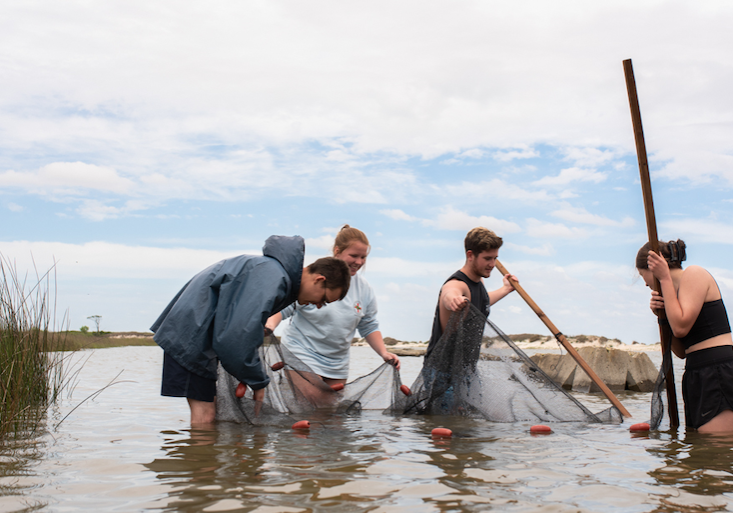
Training the next generation of marine and environmental scientists
by Kathleen Farrell
Upon completing his postdoctoral work at the Institute of Marine Science at the University of North Carolina at Chapel Hill, Dr. Sean Powers received many promising job opportunities. “Every university I spoke with had big expansion plans,” said Powers. “But South actually pulled them off.” Twenty-three years ago, he chose The University of South Alabama’s (USA) program for its merits, as well as its potential for growth. Powers, who was hired as an assistant professor in 2003, was named chair of the Department of Marine Sciences in 2012. In March 2021, the proposal establishing the School of Marine and Environmental Sciences within USA’s college of Arts and Sciences was approved with Powers as its first director. The new school, later named after benefactors Dr. Steven and Angelia Stokes, was created to address environmental concerns of the coastal region by training the next generation of scientists and conducting cutting-edge research.
When Powers first came to USA, the program was graduate students only and primarily located off campus at the Dauphin Island Sea Lab. About 10 years ago, past USA President Dr. Tony Waldrop came to the department with a challenge. While the program in its current state was doing impressive research and helping the university’s reputation, Waldrop noted that the undergraduates weren’t receiving the benefits of the university’s investment. “My response to him was ‘Well, we don’t have any resources on campus,’” Powers said. “So, we spent the next few years thinking about what we would want to do with those resources, if we had them.”
A New Home on Campus
Waldrop retired, and President Joe Bonner, along with Executive Vice President and Provost Dr. Andi Kent, joined in the work. They identified an older building on campus that would become the department’s new home. The entire third floor and part of the second floor of the Education and Outreach Building, originally a cancer research center, was renovated for the first phase — a $4 million project. At the same time, the Alabama Commission on Higher Education approved two new undergraduate programs, a Bachelor of
Science (BS) in marine sciences and a BS in environmental and sustainability sciences. Additional graduate degrees including a master’s degree in marine conservation and resource management and a Ph.D. in environment and society, focusing on the human dimensions of ecology and environmental work, were added.
The newly remodeled space was quickly outgrown. An additional $3 million renovation was made to the first floor and the rest of the second floor. “Right now, we’re at about $7 million in renovations,” Powers
said. “The university has paid for half of that, and we’ve had donors and the State of Alabama pay for the other half. It’s been a very successful partnership.”

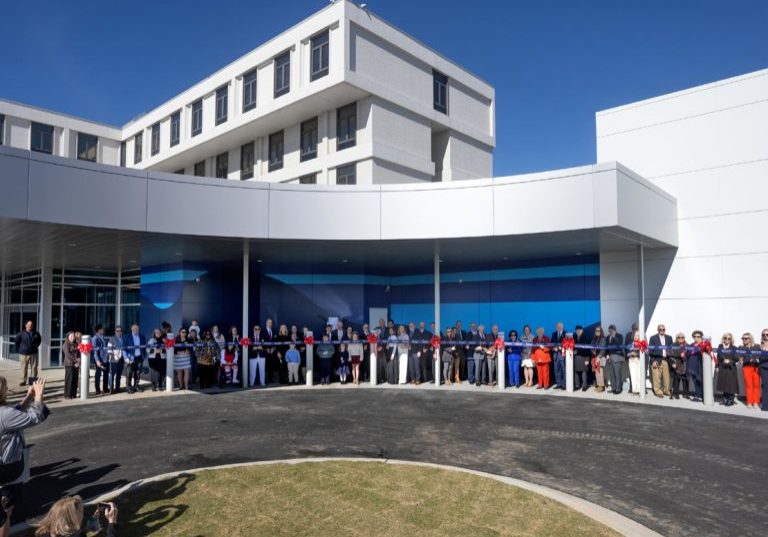
In June 2024, a ribbon- cutting ceremony was held to celebrate the expansion of Stokes School. The 32,000-square-foot facility is filled with glass, including a 600-gallon circular aquarium featuring coastal Alabama marine life. Powers notes that faculty research labs and student teaching labs are situated near each other. “The students get to interact and see exactly what the faculty and graduate students are doing all the time,” Powers said. “Sometimes we feel like we’re in a bit of a fishbowl, but we decided to keep it very open to help us recruit students, as well as encourage donors and partners.” The school has a 6,000-square-foot state-of-the-art analytical facility that can detect any chemical in the ocean or water. In addition to the facilities improvement investment, the university has spent approximately $3 million on instrumentation and equipment.
With the new building and degree programs came an explosion of enrollment. Powers said:
“We thought, at the end of four years, we would be fortunate to have 80 undergraduates across the two majors. As of August 2025, we have 243 students. That coupled with graduate student growth, from 49 graduate students when I first took over as chair, to more than 100 students. Our original goal was a combined total of 120 graduate and undergraduate students, and we have 350.”

Research From Pole to Pole
The Stokes School has added more faculty, growing from six to 20 teacher-researchers, in response to the influx of enrollment. Ten years ago, the Marine Science department received approximately $800,000
in new awards each year. That total has increased to $7 million in new research awards annually. “Our old total research portfolio was about $3 million,” Powers said. “It is now $28 million.”
The School of Marine and Environmental Sciences’ reputation was built on its marine fisheries program, which studies inshore and offshore fish species and provides advice for sustainable management of those natural resources. The Stokes School boasts a diverse array of research projects. “We literally work from Antarctica to Alaska and pretty much every place in between,” Powers said. “One faculty member has had an experiment on the space station, and also just returned from a cruise to the Mariana Trench, the deepest part of the ocean, to do sampling.”
Powers notes that USA has a wide-reaching reputation in marine sciences. “When we started, we realized that we were more known nationally and internationally than locally,” Powers said. “A lot of the growth in research and student enrollment has come from realizing that we need to have more outreach and notoriety in South Alabama and the Gulf Coast region.” Sustainability, environmental sciences and land use practices are among the school’s signature research programs.
The Stokes School’s expanding research has been focused on understanding the Mobile-Tensaw River Delta, coined “America’s Amazon” by writer Ben Raines. Powers says the research is centered around learning how important this incredibly biodiverse area is for fisheries, the environment, carbon storage and to combat climate change. The only four- year state university in Alabama located near the Gulf, the Stokes School and its students have benefited greatly over the years from their connection to the Dauphin Island Sea Lab.

Impact on Industry
Fishing is an approximately $3 billion industry in Alabama, Powers notes. “We have both commercial and recreational fisheries, and our research is always done with the idea of how to better manage and utilize
those resources,” he said. Recognizing that the coastal ecosystem can be fragile and prone to disasters like hurricanes, storm surge and sea level rise, some of USA’s faculty researchers work with municipalities and builders to try to improve the resilience of buildings and infrastructure. The Stokes School partners with industry to understand how their work impacts the environment and how that impact on water and air quality can be lessened. Powers said:
“The research we do at the school spans basic science — science we don’t know if there’s a marketable or industry use for yet — all the way to what we call applied sciences, which is when state managers or industry approach us with a problem, and we do the research needed to solve the problem.”
The Stokes School works with a variety of community foundations and industry members with the goal of
preserving sustainable and healthy coastal resources. “The Alabama Department of Conservation and Natural Resources is our biggest single partner, but we also partner with the cities of Mobile, Dauphin Island and Gulf Shores,” Powers said. “We partner with companies like Volkert and Thompson Engineering— concerned citizens that want to do the best they can for the environment.” The Stokes School works with non-governmental organizations such as the Alabama Coastal Conservation Association, the Nature Conservancy and Alabama Coastal Federation.
“The current university administration has really challenged us to have an impact on the Gulf Coast, while ensuring that these students are the most competitive for jobs,” Powers said. “All of this growth has been balanced with aggressive career placement and internship programs.” The program has seen great success through these efforts. Ninety percent of graduate students have found employment in their field by six months after graduation. “We’ve never lost sight of the student,” Powers said. “Research is impressive, and it gets a lot of attention, but the reason we do research and seek research grants is to train students.”
-
Alabama Coastal Conservation AssociationAlabama Coastal FederationAlabama Department of Conservation and Natural ResourcesCDFL Architects + EngineersDauphin Island Sea LabDr. Andi KentDr. Sean PowersDr. Steven StokesDr. Tony WaldropJoe BonnerMobile-Tensaw River DeltaStokes School of Marine and Environmental SciencesThompson EngineeringUSAUniversity of South alabamaVolkert

Read More

Subscribe to our weekly newsletter
Sign up here for free to get Bay Business News email newsletter every Friday.
By subscribing, you agree to our User Agreement and Privacy Policy & Cookie Statement.